


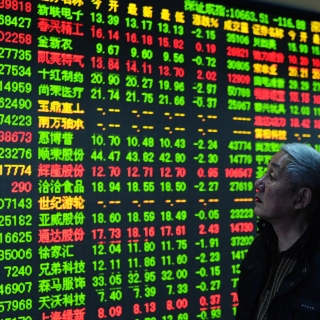
Asian equities swung between small gains and losses as investors weighed the fallout from the selloff in global stocks, with traders watching whether regional markets can stabilize after Wall Street's sharp losses.
MSCI's stocks gauge for Asia Pacific fell around 0.1% after the index had its biggest drop since early April.
Contracts for US stocks edged lower in early Asian trade after the S&P 500 index fell for a fourth day. A basket of the Magnificent Seven companies declined 1.8%. Nvidia Corp., at the center of the AI frenzy, slumped 2.8% ahead of its earnings report after Wednesday's close.
Bitcoin steadied to trade around $92,500 after briefly dropping below $90,000 Tuesday to spook market sentiment.
A selloff in the world's largest technology companies drove stocks to their longest slide since August, underscoring the US market's narrow reliance on a handful of growth giants. Wall Street has grown increasingly concerned that AI isn't yet generating enough revenue or profits to justify the massive spending on infrastructure.
"The question isn't really whether we're in a bubble," said Sonu Varghese at Carson Group. "The real question is how long the current trend in AI spending will last and how bad the fallout will be when it ends." The S&P 500 is down more than 3% this month, on pace for its worst November since 2008. Volatility has roared back. Wall Street's so-called fear gauge, the Cboe Volatility Index, topped 24 — above the key 20 level that causes concern for traders — and reached its highest in a month.
Another major focus for investors is whether the Federal Reserve will cut interest rates next month. Traders have less conviction about another reduction in borrowing costs, with swaps now implying a less-than-50% likelihood of a December move. Several policymakers have recently cautioned against one, citing the risk of inflation, although Fed Governor Christopher Waller repeated his view in favor of lowering rates.
Source: Bloomberg
Tested EN...
Asian stock markets weakened for the second consecutive day, indicating that the initial rally that had been "speedy" at the start of the year is starting to lose steam. At the same time, US governmen...
US stocks were mixed on Wednesday as investors weighed uneven economic data against expectations for eventual Federal Reserve easing, with the S&P 500 easing 0.2% and the Dow Jones sliding 0.8% fr...
European stocks were in mixed territory on Wednesday morning, as regional market jitters grow over U.S. President Donald Trump's threat to annex Greenland. The pan-European Stoxx 600 was little chang...
Asian stock markets weakened slightly on Wednesday after posting their best start to the year in history. The decline was driven by a decline in Japanese stocks amid escalating tensions with China. Th...
Oil prices stabilized on Thursday (February 12th), as the market reassigned a risk premium to US-Iran tensions despite US inventory data showing swelling domestic supplies. This movement confirms one thing: geopolitical headlines are still more...
Gold prices weakened slightly on Thursday (February 12th), as more solid US employment data reduced market confidence in an imminent Federal Reserve interest rate cut. The strong employment data prompted market participants to shift expectations of...
The Hang Seng Index reversed its downward trend in Hong Kong on Thursday (February 12th), weakening by around 0.9% to around 27,000 after a strong session earlier. This decline halted the momentum of the short term rally, as investors began to...